
Fairbairn 4 – Basics of Fairbairn and Object Relation Psychology
Important Note:
Please read the definitions at the end of article alongside the article content. Also, for those who are familiar with Psychology terms, I strongly recommend to read the terminology section in this article because in some instances, the same terms are used differently in different Psychology schools of thoughts (e.g. Freudian vs Jungian).
—
In one of the previous article, I said that the most important reason why early parental/caregiver/guardian relationship to a person affects a person’s psyche so much is because the relationship has unconditional dependent character. The infant/child is completely helpless and completely dependent on his “object.” This is not just for satisfying relationship, but for everything else including his very survival. Thus, there is unconditional and single minded focus on object in an infant relationship to the object unlike in the case of mature adult relationship, which is much more wide spread.i
The important detail here is that most of times, parents do not fail child totally, but depends on parents, they may fail 30% of times, 50% of times, 80% of times, and such. Those times when parents do care about child, it delays the psychological development of child and child cannot really function properly in the world with balanced attitude, but carry some sort of complexes / neurosis which hinders, creates stress, stigma, relationship problems in all types of endeavor. It should be noted that parents does not have to be 100% perfect. However, parents must provide nurturing that is “good enough” while the child is growing up to an adult so that the child can become mature and not stuck at infantile form in one aspect or another (Celani, 2011). When maturity happens, a child accept the fact that a person can have both good and bad aspects. This is called “achieve ambivalent attitude” toward a person – which is not having a black/white view of a person (as in absolute worship or complete detest), but having a realistic view, accepting that both good and bad quality is in a person.
What happens when there is not enough nurture on the part of parents? The child compartmentalize and dissociate that fact. In such a vulnerable state – as in an infant/child – the child cannot accept that his parent is neglecting/abusing him, so what the infant does is hold that negative introjection into a separate object – i.e. “Bad Object”.
The child cannot consciously accept the fact that his parent is neglecting/abusing him because his life utterly depends on his parent. So what happens is that the child pushes the neglecting/abusing part of his parent within his psyche into his unconscious because this fact is too traumatic for his existence at that age. This way, the child can still love and have relationship with the parent. This way, the child does not consciously accept the fact that the parent is neglecting/abusing him when he has no other option.
In adult relationship, if someone is neglecting/abusing another person, he has choice to leave that person and/or choose another, but for a child that option does not exist. Because this is the case, added with lack of mental maturity, the only thing child can do is to dissociate the psyche formed by the fact and events of abuse/neglect and push it down into his unconscious. This becomes the “Bad Object.”
That is the first process of splitting. The split part of internalized parent as an object does not stay as one object. The bad object internalized undergoes another second process of splitting.
With abusive/neglectful parent, the child does not receive nurture good enough to develop. But child still has that developmental need and this need has to be voiced constantly without facing the fact that the parent is abusive/neglectful. This makes the child essentially reduced to beggardom in searching for nurture he needs from the same parent who neglect/abuse him. So in order to meet that thirst of innate developmental need, without facing this painful and devastating truth, the child split that bad object into another two parts – the bad object split into “Rejecting Object” and “Exciting Object.”
Each of these internalized objects have corresponding egos that are split from the original central ego. The Rejecting Object is paired with the Antilibidinal (=Anti-libidinal) Ego, which is motivated to reform and/or destroy the Rejecting Object (internally and externally). The Exciting Object is paired with the Libidinal Ego, which is motivated to get nurture it needs from the Exciting Object (this process involves pleasing the Exciting Object).
The original bad object is the rejecting object. The second part “exciting object” is fantasy based. David Celani (2025) puts it this way:
This second, fantasy-based view of the parent was called the “Exciting Object” by Fairbairn. The libidinal ego and the exciting object engage in a long-term dialogue with each other, which is unknown to the other structures. The libidinal ego prevents the humiliating and rejecting relationship between the antilibidinal self/rejecting object from overwhelming his ability to remain attached to the parent. Thus, the fantasy that there is the possibility of love coming from the exciting object keeps the terror of abandonment at bay.
“The two separate levels of splitting, First the good/bad object split and then the second split of the bad object into its rejecting and exciting components produces three separate pairs of self and objects, one conscious and two unconscious. This “multiplicity of egos” may sound like the beginnings of a multiple personality—and in fact, it is.” – David P Celani (2025)
Each internalized object in the child have each corresponding compartmentalized ego with that object, making three pairs of the internal structure.
So these Three Pairs Are:
Central Ego: the original ego that is attached to the Ideal Object.
Ideal Object: (sometimes this is called “Idealized object”, but I will stick with “Ideal Object”ii) the internalized part of parent/external environment that is good enough and nurturing.
Antilibidinal Ego: the split part of ego from the central ego that is attached to the rejecting object.
Rejecting Object (also called Rejecting/Attacking Object): the internalized part of parent/external environment that is bad (abusive/neglectful).
Exciting Object (also called Exciting/Disappointing Object): the internalized part of the parent/external environment that is exaggerated and fantasy based.
Libidinal Ego: the split part of ego from the central ego that is attached to the exciting object.
Below is the diagram of the three pair structure of the psyche.
< Fairbairn’s Model of Endopsychic Structureiii >
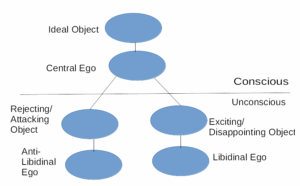
The Central Ego holds the memory of the real nurturing memories internalized as “Ideal Object”. The antilibidinal Ego holds the memory of neglect/abuse memories internalized as “Rejecting Object”. The Libidinal Ego holds the fantasy of what the child want parent wish to be and this fantasy is
“Exciting Objectiv” The “Exciting Object” is also called Exciting/Disappointing Object. The reason why there is word “disappointing” is because it never fulfills the need of the child (as that is the reality) but it is exciting at the same time because even though it disappoints, holds the promise of love (albeit it is based on fantasy), which libidinal ego believes is just right around the corner. This is in order to cope with the unacceptable fact that the parent is abusive/neglectful because child does not have any other choice but to have a relationship with that parent in the face of abuse/neglect.
—
Important note on the term “Ideal Object” and why I only want to stick with “Ideal Object“, but not “Idealized Object”:
Note that the “Ideal Object” is not idealized with fantasy, but idealized with actual work. The parent actually do good work and good introjection to the child and that’s how the Ideal Object is idealized.
Personally, I do not like the use of the term “Idealized Object”, interchangeably with “Ideal Object”. I insist it only asthe “Ideal Object”. In the contemporary Fairbairn definition, idealization of the ideal object happens not by child idealizing it, but by the parents ideal work, thus it does not happen internally in the child’s mind, but externally from actual parental work that is done for the child.
Becausethe standard definition of idealizing that is used in everyday term happens inside one’s mind,often as fantasy, there is ample room for confusion.In Fairbairnian definition, the word “idealized” in the context of “idealized object” it happens outside one’s mind.
This can be confusing especially because the standard meaning of ‘idealizing’ is how the libidinal ego look at its exciting object.
I will say it again: An Ideal Object is a real object – i.e. realistic aim of external world, and/or a person who actually meets the reasonable relationship expectation consistently. Therefore to me, “idealized object”sounds like how the fantasy based libidinal ego looks at the exciting object (both internally and externally), in order to avoid the painful truth of the neglectful/abusive situation that is internalized as bad object in order to keep up the hope about the parent (also external situation) which, in reality iscause of all the mayhem.
But, as it stands,in the contemporary Fairbairnian definition, the Ideal/Idealized Object is internalized part of external world that is from parent/caregiver that was/is nurturing/supporting the child. I want to make it clear that in Fairbairn Psychology, Ideal/Idealized Object is not Ideal/Idealized by the child in the way how the child looks at the parent, but by the parent’s actual good work, the parent’s good introjection toward the child – by the support and nurture for the child. And because it can be confusing with standard definition, I will only use the term, “Ideal Object”, not idealized object.
Also, “Ideal Object” is called as “Good Object”. Here, keep in mind that Good Object can never be the “exciting object,” but only the “Ideal Object”.
Thus:
-
- Good Object = Ideal Object
- Bad Object = Rejecting Object + Exciting Object
Bad Object is sum of rejecting object and exciting object. This is because both rejecting object and exciting object came from the bad object by splitting the bad object into two. The ego that is corresponds to the bad object is also split into two; they are anti-libidinal ego, which is attached to the rejecting object, and libidinal ego which is attached to the exciting object.
Therefore, both rejecting object and exciting object can be called as bad object.
—
In Fairbairn’s mind model, everyone has Central Ego-Ideal Object pair. Once a child face bad enough abuse/neglect, the Central Ego splits into to two, one holds good object (=ideal object), another holds bad object. This bad object split second time to produce “Rejecting Object” and “Exciting Object.” The “Antilibidinal Ego” is attached to the “Rejecting Object” and “Libidinal Ego” is attached to the “Exciting Object.”
In Fairbairnian psychology, the unconsciousv does not form if there is good enough nurture where child can grow up with good enough amount of love and support. The size and strength of the split egos depends on the types, durations, and intensity of abuse/neglect.
Keep in mind that each ego has its own corresponding object, because ego is object seeking. Libido, in Fairbairn’s term, is merely a function of ego. This aspect of object relation to ego was totally ignored in Freudian psychology. Fairbairn said Freud put the cart before the horse regarding thisvi.
It has been suggested that Antilibidinal Ego can take over the Central Ego in its conscious function, which Fairbairn originally thought was not possible. This was suggested from the many years of observation in clinical practice. It also seemed that Libidinal Ego can also take over the Central Ego in its conscious function as well. In fact both are true – both the anti-libidinal ego and libidinal ego can take over the central ego. The pattern of alternating consciousness that is taken over by Antilibidinal or Libidinal Ego replacing Central Ego has been observed many times by therapists. (Celani, 2010)
When anti-libidinal ego takes over, the person looks outside world in cynical/adversarial way with passive-agressive attitude. The rejecting object is projected outward toward the person who did bad introjection, i.e. parent. Or it could be therapist (if he had transference to the therapist that is) or anyone who had transference on – that person could be spouse, boss, their own child, sibling, relative, friend, co-worker, etc.
When libidinal ego takes over, a person minimalize/trivialize/forgot about the abuse/neglect he has received and such memory or he idealize the therapist as if the therapist holds unrealistically high promise of love and nurture (if he had transference to the therapist that is). This may sounds good, but it isn’t. Because what libidinal ego believes is based on fantasy, how it relates to the external world is also fantasy-based, fleeting, and unstable. The slightest sign of the therapist that does not match to this internal image, the patient may switch to the anti-libidinal ego. Also, because libidinal ego is always accompanied by antilibidinal ego, the relationship the person engages in the external world also has corresponding abusive/neglectful element that accompanies the relation between anti-libidinal and reject object. When there is no antilibidinal element, the person would often try to recreate that in the relationship (albeit it may be unconsciously done) that reflects antilibidinal ego or leave for the other person (e.g. switching therapists and personal relationships).
The big problem here is that neither antilibidinal ego and libidinal ego do not know what the other is really doing to the whole system of the entire self. What need to be done here is to gradually bringing this to the person’s awareness at the same time build central ego, avoid the negative interaction due to the transference, (also avoid countertransference), support the mental development, and help him to get out of negative relationship – which is no small feet. A therapist (Fairbairnian Object Relation therapist in this context) may work out this with the patient with whatever the help the patient can get.
Again, both antilibidinal and libidinal ego can take over the position of central ego as the conscious self. The central ego is what makes the stable life possible with any possible stable and fulfilling future relationships. When central ego gets smaller, the complex/psychosis that person have gets worse. Also, both libidinal and antilibidinal ego results infantile arrest in development. Both the enlargement of libidinal ego and/or antilibidinal ego leads to reduction of central ego.
In order to incorporate antilibidinal/libidinal ego into the central ego, the continual and consistent nurture and support is necessary in the person’s environment and also in therapy. David P. Celani, a Fairbairnian psychologist said that it usually takes about 5 years of therapy to restore the central ego, which also should be accompanied by mental development of a patient who has child abuse/neglect history. Of course, it is essential on the part of the patient that he truly wants to get better, and also withdraw himself from the original family which created the situation (or adopted family if that family also has the similar dynamics as with original family) – which is usually a slow process.
There are two other case a person can switch its conscious into, and that is when a person identifies itself with the Rejecting Object (instead of Antilibidinal Ego) or Exciting Object (instead of Libidinal Ego).
When a person identifies himself with the internalized “Rejecting Object”, the person enacts all the abuse/neglect it has received onto another person – usually to the person who had nothing to do with that abuse/neglect. This leads to criminality and inter-generational abuse/neglect. It is the worst case scenario.
When a person identifies himself with the internalized “Exciting Object”, the person will try to do everything to achieve that idealized fantasy image of self. This can actually lead to social achievement. However, the problem here is that slightest variation and/or disappointment of this image (supporting of this image) leads to the “Drive Diffusion.”(Celani, 2014) In other words, he loses the drive to achieve that image, for slightest reason/external events which cause panic/depression. Because Exciting Object itself is based on fantasy unlike that of Ideal Object that is based on reality. So in any cases, it is essential to build Central Ego and absorb Antilibidinal and Libidinal Ego.
When there is no nurture/support, antilibidinal and libidinal ego searches for ‘Substitutive Satisfaction.’vii This is manifested as addictions of many different types and forms – substance, relationship, and/or behavioral wiseviii – i.e., drug addiction (both prescription/non-prescription), alcohol/tobacco addiction, food addiction (usually in the form of excessive meat, excessive fatty/sugary/salty food, junk food, etc.), anorexia, dysfunctional relationship (i.e. frequent break-ups/divorce, multiple sex partners, etc.), obsessive compulsive behavior, self-sabotaging behavior, immoral behavior (i.e. compulsive stealing, etc.), violent behavior, workaholic, exercise addiction, desire to have children (despite of one’s bad/inappropriate mental/physical/financial state)ix, megalomania, severe/chronic depression, etc.x This is why child abuse/neglect is extremely detrimental not only to mental health, but also physical health as well – as shown in ACE (Adverse Childhood Experiences) Scores. Please see the definition section for what “ACE (Adverse Childhood Experiences) Scores” means – I highly recommend everyone to look at their ACE Scores.
=================================================
[Definitions]
Definitions are listed alphabetically. There are some psychological terms that are shared in Fairbairn, Freudian, and Jungian psychology. The same words share some definition, but in other cases, it is totally different. I should make a table of those terms and post in later article.
ACE (Adverse Childhood Experiences) Scores
ACE Study is based at Kaiser Permanente’s San Diego Health Appraisal Clinic with CDC (Center for Disease Control)
Researchers studied the relationship between these 10 adverse childhood experiences:
• Child physical abuse
• Child sexual abuse
• Child emotional abuse
• Emotional neglect
• Physical neglect
• Mentally ill, depressed or suicidal person in the home.
• Drug addicted or alcoholic family member
• Witnessing domestic violence against the mother
• Loss of a parent to death or abandonment by parental divorce
• Incarceration of any family member for a crime
These have profound mental and physical health of the person when they become an adult.
For Example:
Children who experience 4 or more ACEs have 10-12 times greater risk for intravenous drug use and attempted suicide. 2-3 times greater risk for developing heart disease and cancer. 32 times more likely to have learning and behavioral problems. 8 out of 10 leading cause of death in the U.S. correlate with exposure to 4 or more ACEs. (CDC 2022)
The social consequent and cost of high ACEs Score is enormous, amounting to billions of dollars a year in USA alone. (CDC 2022)
If you are interested please look at the reference section to read more about ACE and find out your ACE score.
Conscious
Part of self that is consciously aware of. It consists of Ego and persona as sub-ego structure.
Ego
The conscious sense and part of self.
Ego is conscious part of self that has also deals with the external world to meet the external demands/interaction. Ego is the point of self to perceive and process the problems, adjust itself to external stimuli in different manners. Therefore it consist of individual’s mode, social values, preoccupations, attitudes, and such.
Keep in mind that what is domain of ego does not solely belong to the ego. For example, one’s ego can consist of the social paradigm that one is aware of, but that paradigm itself may reach to its unconscious and influence in the way that the conscious self, ego is not aware of.
Since the unconscious is reflection of the entire universe, and our conscious self is such a minute thing, some psychologists say that what is in the driver’s seat is the unconscious.
From “International Dictionary of Psychoanalysis Vol 1, 2, 3”
p463
“In reality the ego is like the clown in the circus, who is always putting in his oar to make the audience think that whatever happens is his doing’’ (Freud/Jung Letters, p. 400) This book quoted Freud-Jung Letters.”
So does it matter what we actually think and feel? Indeed yes it does. What we consciously do everyday is transferred to unconscious and in turn affects our conscious action. But because our unconscious is so vast and our conscious is so small, it takes so much effort in so many repetitive actions/thoughts to accomplish any significant things in life. Which is why changing habit consciously for better is so difficult, but succeed in doing so also gives untold benefit in our mental base that we may not know at the moment, but benefits later. This is also why being repeatedly consistent is key in changing habit and also learning anything.
Id
Entity of primal/primitive instincts and energies that underly in all psychic activity. This is how Freud defined it. In Fairbairnian psychology, Id does not exist. In Fairbairnian psychology, one simply has energy that is changeable by relationships – not as an entity.
Introjection
Dictionary definition is:
“1. a process in which an individual unconsciously incorporates aspects of the external environment into the self, particularly the attitudes, values, and qualities of another person. Introjection may occur, for example, in the mourning process for a loved one.
2. in psychoanalytic theory, the process of internalizing the qualities of an external OBJECT into the psyche in the form of an internal object or mental REPRESENTATION, which then has an influence on behavior. This process is posited to be a normal part of development, as when introjection of parental values and attitudes forms the SUPEREGO, but may also be used as a DEFENSE MECHANISM in situations that arouse anxiety.
—introject vb. —introjective adj.”
– from APA College Dictionary of Psychology – American Psychological Association 2009
In the Fairbairn psychology, both 1 and 2 definition qualifies as introjection, thus, what is introjected can be a person, group of people, animal, environment, atmosphere, object, custom, culture, mental attitude, emotional pattern, etc. An introjection can be good, bad, neutral, and all in-between. Here, it ought to be noted that good introjection can be confused with something that is fun and exciting. However, quite contrary, good introjection is usually repeated calm, quite (peaceful) human interaction/togetherness that lasts hours. From accumulated data and observations, it seems that this has the most positive benefit in child development and also in healing all types of psychological complexes.
Libido
Dictionary definition:
“ln psychoanalytic theory, either the PSYCHIC ENERGY of the LIFE INSTINCT in general, or the energy of the SEXUAL INSTINCT in particular. In his first formulation, Austrian psychiatrist Sigmund Freud (1856-1939) conceived of this energy as narrowly sexual, but subsequently he broadened the concept to include all expressions of love, pleasure, and self-preservation. See also EROS. —libidinal adj. —libidinize vb. —libidinous adj.”
– from APA College Dictionary of Psychology – American Psychological Association 2009
Libidinal in Fairbairnian term, is life energy that involves in every activities of human life.
It should be noted that there are difference ways of defining libido in Freudian, Jungian, and Fairbairnian terms.
- Freudian limit libidinal energy only as sexual energy, so for Freud, libidinal energy=sexual energy. Freud later added all expressions of love, pleasure, and self-preservation.
- Jungian consider libidinal energy as life energy which includes sexual energy. All the energies can be transformed/transmuted into other forms.
- Fairbairnian regards libidinal energy as just one way of manifestation of life energy that is according to a relationship. In Fairbairn’s term, the relationship always comes first, thus energy change its form according to the relationship. Energy is just energy. Character is attached to energy according to the relationship/pattern of relationship (and internalized pattern of the external object, i.e. introjection) and changes its meaning according to that relationship, and also according to the internal structure of a person formed by the relationship to outside world, i.e. introjections. Energy itself does not have a character, but the relationship is what gives the energy character. So if one has a bad relationship and that is an internalized pattern within that person (due to bad introjections), the energy will manifest in such way. This is why Fairbairn said Freud made mistake in “putting the cart before the horse”
Regarding “putting the cart before the horse”, Fairbairn said,
“It must always be borne in mind, however, that it is not the libidinal attitude which determines the object-relationship, but the object-relationship which determines the libidinal attitude.” (34)
Fairbairn, R. (1994). Psychoanalytic Studies of the Personality. Routledge.
I have elaborated in one of the previous article:
“Psychology and Sustainability: 2. Freudian vs. Fairbairnian Psychology – Pleasure vs. Relational Based Psychology.”
https://www.linkedin.com/pulse/psychology-sustainability-2-freudian-fairbairnian-pleasure-h-lansel-m997e/
—Starting a quote from the article—
The truth is that not all neurosis comes from sexual trauma, but all come from mental and/or physical neglect/abuse (either by self and/or by others). Instead, Freud completely reversed his original position (which confirms that neurosis comes from mental and/or physical neglect / abuse) by discarding it. As a result, his theory became “blaming the victim” for the cause of psychological complexes. This led to an egregious error in diagnosing a patient in psychotherapy.
Thus, the dynamics of psychic energy flow (or economy of psychic energy) became upside-down because it seemed that Freud was socially semi-pressured to cater to the abusers and others who wanted to keep the status quo who were willfully ignorant and morally cowardly. As a result, he made the theoretical ‘error'(if it can be called error, that is) of “putting the cart before the horse,” as Fairbairn puts it.
“The conception of fundamental erotogenic zones constitutes an unsatisfactory basis for any theory of libidinal development because it is based upon a failure to recognize that the function of libidinal pleasure is essentially to provide a sign-post to the object. According to the conception of erotogenic zones the object is regarded as a sign-post to libidinal pleasure; and the cart is thus placed before the horse. Such a reversal of the real position must be attributed to the fact that, in the earlier stages of psychoanalytical thought, the paramount importance of the object-relationship had not yet been sufficiently realized.” (33)
Fairbairn, R. (1994). Psychoanalytic Studies of the Personality. Routledge.
“It must always be borne in mind, however, that it is not the libidinal attitude which determines the object-relationship, but the object-relationship which determines the libidinal attitude.” (34)
Fairbairn, R. (1994). Psychoanalytic Studies of the Personality. Routledge.
—End of a quote from the article—
Object
A person or symbolic representation of a person, or an object/symbolic representation of that an object other then self. Thus, Object ≠ Self. Object is “the other”. It is whom one’s behavior, cognitions, or affects are directed to. Intangible stuffs can be an object. For example, an “interest” can be considered as an “object”. However, the other as a person, is far more typical.
Thus any person, interest, or external object can be an object. In other words, an object is a focal point of projection from a person (or persons) with libidinal investment (life-energy investment). Please see “libido” section for its definition.
“Persona” and “Frontal Persona“:
Persona: referring to a psychological term, especially in Jungian psychology.
It is a personality and a portion of the ‘Self’ that one presents (=show) to the world. In other words, a personal facade that one presents to the world. This has nothing to do with someone being hypocritical or duplicitous. However, it does give more conscious awareness to that particular part of the ‘Self.’
Different from the ego in that the persona can be switched consciously and/or unconsciously. By ‘switched’ here, I mean a person has many personas and can make a certain persona comes forward as a set of mode(s) of interacting with the world. The persona that is in the front of a person that currently interact with the world is called the ‘Frontal Persona.’ So for example, let’s say a person’s profession is a doctor. When that person is in the hospital doing his ‘doctor’ work he has particular set of mental and emotional mode that interact with patients and hospital staffs. He is also a father. So when he comes home, he switch into the ‘father’ mode. These different individual sets of modes are called persona.
Each different persona do not have clear boundaries, but approximate boundaries, and that is normal. If they have absolute clear boundaries with each other where one persona does not even know the other persona exists, it is a mental disease called Multiple Personality Disorder (MPD), or also called Dissociative Identity Disorder (DID).
Ego is the entire conscious part of a human, a person.
It is interesting in that different persona has different strength of connection to different types of archetypes (usually, but not always). So for example, if a person is in father mode, (the father persona) when he is interacting with family, the connection to the ‘father archetype’ is greater than the connection to the ‘healer archetype’ when he is in the hospital as a doctor, which means his conscious mind, (=ego) is a lot more open (= receptive) to the bigger unconscious part of that archetype and likely to learn something within that domain of that particular archetype than the other.
Projection
This is a mental process which a person attributes one’s own characteristics, affects, impulses to another person, group, or object(s). This is used in many ways such as identification, idolization, setting life ideal, and also as defense mechanism.
In defense mechanism, projection is used in which unpleasant or unacceptable mental state, impulses, ideas, affects, stressors, or responsibilities are attributed to others who has little or nothing to do with actual cause of such mental state. Typical example of this is, abusers attributing the cause of abuse to its victim. In other words, projection is avoidance of one’s own mental state/attitude/thoughts/feelings/etc. by attributing/imposing one’s own mental state onto another.
Since projection can be done to an object – as in both internal and external object – it can be done to one’s part self. For example, a child who is often abused by his parents cannot accept the fact that his parents are abusive people who does not care of his own well-being, since his very life itself is dependent on his parents. So the child redirects his anger toward his parents to his own internal bad object, and later develops into self harm. Projection used in such way as a defense mechanism is called “moral defense” in Fairbairnian term (in other words, morally defending and thus justifying his parents for their wrongdoings). Note that the internal bad object itself is originated from the parents behavior toward the child, which makes his parents responsible for forming the bad object in the child in the first place.
People idolizing celebrities and political figures are projections as well, it is a form of projective identification. This is why celebrities and politicians are so careful about their images, so as to not to outwardly violate this projected expectation of the public onto them – whatever they may actually live like that and do is another matter – so that they can keep their popularity and votes.
Projective identification is a way of relating to a person or a group of persons. More psychically mature a person is less the person identify with the other with projective identification, but with more conscious self in more conscious manner.
The full of opposite sex is unconscious projective identification. This is because everyone has male and female version of self in their psyche. So a person who is male, is attracted to his unconscious female version of his own psyche, and vice-versa for female. Self understanding and self analysis is essential in making sense of unreasonable behavior of male-female relation into more reasonable and conscious relation.
Self
An entire self of a being. This consist of conscious and unconscious with their corresponding sub-structures. In Fairbairn term, it is the self that consist of all the internalized part and all its corresponding egos.
In Jungian term, self consist superego like Freud but also consist of shared self with others, such as archetypes. It also consist reflection of the entire universe. In Jungian, Self is mysterious in that its own identity contains the entire reflection of the universe – like microcosm within a macrocosm. Carl G. Jung’s book “AION: Researches into the Phenomenology of the Self” is an attempt to show this in articulated manner.
If anyone is interested in Jungian definition of self and want to read his book, “AION: Researches into the Phenomenology of the Self” I recommend to only read the forward of the book, Chapter 15, and The Conclusion. If you are up to it, then read Chapters 1-4. The rest of the chapters, are not necessary to read in order to understand the main point of the book.
I really wish someone told me beforehand that I don’t have to read this book in its entirety to understand Jung’s main point in this book. Because after reading this, for a while, I got demotivated on studying psychology because it was extremely difficult to read. This was at least 3 times difficult for me to read than “On Liberty” by John Stuart Mill – and I am not a native English speaker.
Substitutive Satisfactions
“Frustration of his desire to be loved as a person and to have his love accepted is the greatest trauma that a child can experience; and it is this trauma above all that creates fixations in the various forms of infantile sexuality to which a child is driven to resort in an attempt to compensate by substitutive satisfactions for the failure of his emotional relationships with his outer objects.” (39)
Fairbairn, R. (1994). Psychoanalytic Studies of the Personality. Routledge.
Superego
Freudian definition is, “the part of the unconscious mind that acts as a conscience.” He estimated that superego develops around age of 5, by internalizing the moral standards and ideals from parents and society. However, to define this merely as conscience is not entirely accurate. It seems to me, by defining Superego as conscience, Freud made implicit mistake of assuming that all standards/ideals by parents and society is good, which is not true. I think superego cannot automatically act as a conscience. I also think that conscience has element that is something beyond what one has learned from parent and society. For example, children before speaking age show care/sympathy/empathy of small animals/pets even it was not taught by their parents/society. Indeed, good introjection alone gives such tendencies of care/sympathy/empathy to other animals and fellow children.
Thus, it seems to me at least, that the superego is merely internalized moral standards and ideals from parents and society, and it can be part of conscience, but not necessarily the entire conscience.
Unconscious
Part of self that is not aware of consciously. Only in that sense Freud and Fairbairnian psychology. However, in Freudian psychology, unconscious is Id and superego, whereas in Fairbairnian, unconscious is bad objects and corresponding ego structures. So in Fairbairnian, unconscious has a type of sub-structure similar to conscious as explained in Fairbairn endopsychical model.
In Jungian psychology, the unconscious is regarded as enormously large part of a self’s psyche, which may be the reflection of the entire universe. In MBTI (Myers-Briggs Type Indicator) psychology, which is refined and developed from Jungian personality psychology, the unconscious is the function of mind that has not yet developed, usually the tertiary/inferior functions plus the shadow functions within a person.
=======================================
[ References ]
APA College Dictionary of Psychology – American Psychological Association 1st Ed
Gary R. VandenBos, PhD APA Publisher
Gary R. VandenBos, PhD editor in chief
2009
Published by
American Psychological Association
750 First Street, NE
Washington, DC 20002
APA Concise Dictionary of Psychology – Gary R. VandenBos, PhD APA Publisher 1st Ed Gary R. VandenBos editor in chief
2009
Published by
American Psychological Association
750 First Street, NE
Washington, DC 20002
APA Dictionary of Clinical Psychology – Gary R. VandenBos, PhD APA Publisher Also Editor in chief
2013 1st Ed
American Psychological Association
750 First Street, NE
Washington, DC 20002
www.apa.org
Artha Dictionary. (Version: 1.0.3-1+b1). [Computer Software for Linux Operating System]. Debian Science Team. http://artha.sourceforge.net/
International Dictionary of Psychoanalysis Vol 1, 2, 3
Editor in Chief: Alain de Mijolla
2005 Thomson Gale, a part of the Thomson
Corporation
Macmillan Reference USA
An imprint of the Gale Group
27500 Drake Road
Farmington Hills, MI 48331-3535
http://www.gale.com
Artha Dictionary. (Version: 1.0.3-1+b1). [Computer Software for Linux Operating System]. Debian Science Team. http://artha.sourceforge.net/
Artha 1.0.3
A handy off-line thesaurus based on WordNet
Copyright © 2009 – 2012 Sundaram Ramaswamy
WordNet 3.0 Copyright 2006 – 2012 by Princeton University. All rights reserved.
Bancroft L. (2003). Why Does He Do That?: Inside the Minds of Angry and Controlling Men. Penguin.
CDC – Center for Disease Control and Prevention. (n.d.). Preventing Adverse Childhood Experiences. Retrieved March 12, 2022, https://www.cdc.gov/violenceprevention/aces/fastfact.html
CDC – Center for Disease Control and Prevention. (n.d.). Preventing Sexual Violence. Retrieved March 12, 2022, from https://www.cdc.gov/violenceprevention/sexualviolence/fastfact.html
Celani, D.P. (2014). A Fairbairnian structural analysis of the narcissistic personality disorder. Psychoanalytic Review, 101(3), 385-409.
Celani, D.P. (2020-06-29). Object Relation Institute “Working with Fairbairns Metaphors of the Human Mind in Mental Health” https://www.orinyc.org
Celani, D. P. (2010). Fairbairn’s Object Relations Theory in the Clinical Setting. Columbia University Press.
Celani, D. P. (2011). Leaving Home: Art of Separating from Your Difficult Family. Columbia University Press.
Celani, D. P. (1994). The Illusion of Love: Why Battered Woman Returns to Her Abuser. Columbia University Press.
Fairbairn, R. (1994). Psychoanalytic Studies of the Personality. Routledge.
Felitti, V. J., Anda, R. F., Nordenberg, D., Williamson, D. F., Spitz, A. M., Edwards, V., Koss, M. P., & Marks, J. S. (1998). Relationship of childhood abuse and household dysfunction to many of the leading causes of death in adults: the Adverse Childhood Experiences (ACE) study. American Journal of Preventive Medicine, 14, 245-258.
https://www.iowaaces360.org/uploads/1/0/9/2/10925571/relationship_of_childhood_abuse_and…_1998.pdf
Greenberg, J. R., and S. A. Mitchell. (1983). Object Relations in Psychoanalytic Theory. Cambridge, Mass.: Harvard University Press.
Jung, C. G. (1959). Aion: Researches into the Phenomenology of the Self. 2nd ed. (Adler, G., Hull, R.F.C., Trans.) Princeton Press.
Lisle, D. J., Goldhamer A. (2003). The Pleasure Trap: Mastering the Hidden Force that Undermines Health & Happiness. Healthy Living.
Lisle, D. J. (January 2022). Campbell, T. C. Center for Nutrition Studies and the online Plant-Based Nutrition Certificate [MOOC] eCornell. CNS603 – 3 Plant-Based in Practice.
https://nutritionstudies.org/courses/plant-based-nutrition
============================================
[END NOTE]
i “The outstanding feature of infantile dependence is its unconditional character. The infant is completely dependent upon his object not only for his existence and well-being, but also for the satisfaction of his psychological needs…. We also notice that, whereas in the case of the adult the object relationship has a considerable spread, in the case of the infant it tends to be focused on a single object. The loss of an object is thus very much more devastating in the case of an infant. If a mature individual loses an object, however important, he still has some objects remaining…. The infant on the other hand has no choice. He has no alternative but to accept or reject his object—an alternative which is liable to present itself to him as a choice between life and death.” (47) – Fairbairn, R. (1994). Psychoanalytic Studies of the Personality. Routledge.
“The essential striving of the child is not for pleasure but for contact. He needs the other. If the other is available for gratifying, pleasurable exchange, then the child will enter pleasurable activities. If the parent offers only painful, unfulfilling contacts, the child does not abandon the parent to search for more pleasurable opportunities. The child needs the parent so he integrates his relations with him on a suffering masochistic basis… The emptier the real exchange, the greater his devotion to the promising yet depriving features of his parents which he has internalized and seeks within. In addition he preserves his childhood terror that if he disengages himself from these internal objects, he will find himself totally alone.” (173)
Greenberg, J. R., and S. A. Mitchell. (1983). Object Relations in Psychoanalytic Theory. Cambridge, Mass.: Harvard University Press.
ii For a good reason, which I will explain later.
iii Originally, Fairbairn thought that only Central Ego remains conscious and the other two, the Anti-libidinal ego and Libidinal ego could not be conscious. In other words, he thought the two pairs of substructure could not take over the “Central Ego – Ideal Object” pair. Turns out that this was wrong. Over and over again, the clinical psychologists who applied Fairbairn model, and other psychologists observed that each Anti-libidinal ego and Libidinal ego can replace the position of the Central Ego. I will explain this later.
iv “Exciting/Disappointing” as in, it is exciting because libidinal ego believes nurture is just around the corner, but it is also thinking that it can be disappointing. However, despite of the disappointment, it still believes it is good, so the libidinal ego would keep trying to get nurture and have the hope up. This of course is not counting the fact that in child’s mind there is rejecting object with antilibidinal ego which knows better about what actually happened and such expectation for nurture is illusionary.
v Freud first came up with the term unconscious, which has/holds memories, wish, conflicts, emotions and other part of the psyche that a person does not wish to face and/or not directly accessible. In this sense, Fairbairnian meaning of unconscious has Freud meaning embedded in it. This Fairbairn meaning also in part include the Jungian definition of unconscious, because from looking at the functions of a personality character, the unconscious tend to take the character of tertiary/inferior functions and/or shadow functions. John Beebe (2017), a Jungian practitioner observed this to his patients and other patients. But for the sake of simplicity, let’s just assume that unconscious is the part that split off from the whole ego-self in order to deal with the abusive/neglectful experiences child had – as in Fairbairnian term.
vi “The conception of fundamental erotogenic zones constitutes an unsatisfactory basis for any theory of libidinal development because it is based upon a failure to recognize that the function of libidinal pleasure is essentially to provide a sign-post to the object. According to the conception of erotogenic zones the object is regarded as a sign-post to libidinal pleasure; and the cart is thus placed before the horse. Such a reversal of the real position must be attributed to the fact that, in the earlier stages of psychoanalytical thought, the paramount importance of the object-relationship had not yet been sufficiently realized.” (33)
– Fairbairn, R. (1994). Psychoanalytic Studies of the Personality. Routledge.
vii Freud first came up with this term. It is used in similar way in Fairbairnian psychology as well. The only difference is, in Freudian, this need for substitutive satisfaction would be dismissed because it is immoral, because it is just for sexual gratification, whereas in Fairbairnian, that need of substitute satisfaction is, in original form, what was lacking when child was developing in order to become a fully mature human.
viii It is an understatement to say that many economic and social activities are based on this “Substitutive Satisfaction.” We are deluged by it in this modern time.
ix Not that desire to have children in and of itself is wrong, but among the abused/neglected people some have unconscious wish to be parents so they can be nurtured by their children – just as their parents were nurtured by them (=the role reversal, which was forced upon them) – which was/is very wrong and inappropriate.
x It is not just the Fairbairnian internal structure that is caused by abuse/neglect which lead to such unhealthy choice. It is also because the entire culture and economy is driven by addiction – usually hyper-dopamine inducing activities/drugs/foods. (Lisle and Goldhamer 2003)