
In the previous article, I said that the most important reason why early relationship in a person affects a person’s psyche so much is because the relationship has unconditional dependence character. The infant is completely helpless and completely dependent on his object. This is not just for satisfying relationship, but for everything else including his own very survival. Thus, there is unconditional and single minded focus on object in an infant relationship to the object unlike in the case of mature adult relationship, which is much more wide spread.1
The important detail here is that most of times, parents do not fail child totally, but depends on parents, they may fail 30% of times, 50% of times, 80% of times, and such. Those times when parents do care about child, it delays the psychological development of child and child cannot really function properly in the world with balanced attitude, but carry some sort of complexes and neurosis. It should be noted that parents does not have to be perfect 100%, however, parents must provide nurturing that is “good enough” so that children can become mature and not stuck in infantile form in their part of psyche in one aspect or another. (Celani, 2011)
< Fairbairn’s Model of Endopsychic Structure >
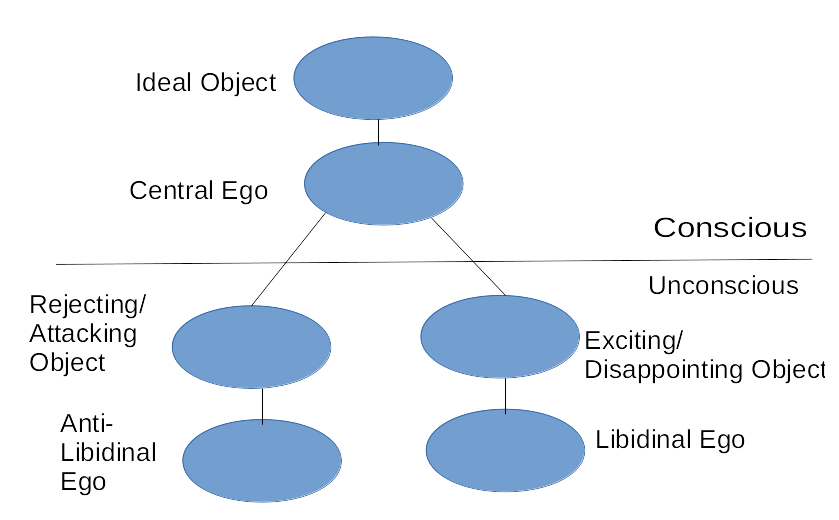
In his model, everyone has Central Ego-Ideal Object pair. Once a child/person face bad enough stress/adversity/trauma/neglect/abuse, the Central Ego splits into to two more others, which are anti-libidinal and libidinal ego. The size and strength of these two split egos depends on the types, durations, and intensity of stress/adversity/trauma/neglect/abuse. Remember, each ego has its own object, because ego and libido (which, in Fairbairn’s definition, is merely a function of ego) are object seeking. This aspect of object relation was totally ignored in Freudian psychology.
The direction of the aggression flows from the Central Ego to Anti-libidinal Ego and Libidinal Ego. Reason is the child/person wants to hide his hatred (anti-libidinal ego) and also wants to suppress too much excitement and unrealistic perspective of libidinal ego2 as well. Anti-libidinal ego attacks libidinal ego, too, as it knows what libidinal ego expect is impossible and unrealistic. The internalized rejecting/attacking object also attacks libidinal ego as well, because it is made to reject/attack the demands and wishes of love. This results reduction of libidinal ego and increase of anti-libidinal ego.
As central ego gets smaller, the type of psychosis of that person gets worse. In many instances, when this happens, anti-libidinal ego can take over the central ego permanently (Celani 2011) and the person loses all the balanced perspective, but left with always bitter/angry temper / world view, occasionally switching to the small libidinal ego with impractical wishes and expectation that is out of balance – or some variation of it. This type of people are shown in all over the world in different types of culture.
To give an example of how this works, let’s take a look at in the case of Hysterical Neurosis.
APA Dictionary of Clinical Psychology – Gary R, Ed VandenBos
Gary R. VandenBos, PhD and others
APA Publisher
American Psychological Association
Washington, DC 2013
Definition:
Hysteria n. the historical name for the condition now classified as SOMATIZATION DISORDER. Although technically outdated, it is often used as a lay term for any psychogenic disorder characterized by such symptoms as paralysis, blindness, loss of sensation, and hallucinations and often accompanied by suggestibility, emotional outbursts, and histrionic behavior. Austrian psychiatrist Sigmund Freud (1856-1939) interpreted hysterical symptoms as defenses against guilty sexual impulses (e.g., a paralyzed hand cannot masturbate), but other conflicts are now recognized. Freud also included dissociative conditions in his concept of hysteria, but these are now regarded as separate disorders.
—hysterical adj.
Hysterical Personality Disorder – see Histrionic Personality Disorder.
histrionic personality disorder in DSM–IV–TR, a personality disorder characterized by a pattern of long-term (rather than episodic) self-dramatization in which individuals draw attention to themselves, crave activity and excitement, overreact to minor events, experience angry outbursts, and are prone to manipulative suicide threats and gestures. Such individuals appear to others to be shallow, egocentric, inconsiderate, vain, demanding, dependent, and helpless. The disorder was formerly known as hysterical personality disorder.
David Celani explains this in his book “Fairbairn s Object Relations Theory in the Clinical Setting.” p24
A structural approach to the hysteric reveals a different inner relational world formed by different family dynamics, such as a depressed, often uninvolved mother and a seductive father who trades what little attention he offers his daughter for premature and inappropriate sexualized behaviors on her part. The child, desperately needy for emotional support, complies and must dissociate the intolerable aspects of the sexualized relationship between her and her father, as these memories of such events cannot be integrated into her central ego. Her unmet emotional needs create a libidinal ego that sees her paternal object (and later all men) as an exciting object, as he offers some nurturance that is exaggerated by fantasy and hope, while her mother is ignored by both her and her father. The relational pattern she internalizes is projected onto all new relationships, and, from the perspective of her libidinal ego, men are approached as exciting objects. The hysteric’s eager, sexualized approach to men is based on her hope for nurturance, and her sexualized behaviors are dissociated so that she approaches each new relationship in a state of “innocence.” The male object often responds to the hysteric’s displays with a sexual proposal, which outrages the hysteric; she immediately represses her libidinal ego, replacing it with her antilibidinal ego, and all the bitter antilibidinal disappointment in men emerges with force.
* please note that when I say unconscious, I mean amalgamated meaning of Freudian, Jungian, and Fairbairnian.
* I used the term, ‘Rejecting/Attacking Object’ same as the ‘bad object.’
* I used the term, libido as life energy that involves in every activities of human life.
This split that happens when a person (esp. a child) receives ‘bad enough’3 trauma / abuse / neglect which cause the split because it is too much for the front persona and the central ego to deal with.
Both of these – fragmented knowledge / sense of self and this split – plays divided / fragmented consciousness in human mind and thus resulting fragmented compartmentalized view of world and self.
Nurture and support with analysis of anti-libidinal and libidinal ego restores the size of central ego.
When there is no such support, anti-libidinal and libidinal ego search for ‘substitute satisfaction.’ This is manifested addiction to different types. And these are also manifested as 1. More Meat Consumption 2. Food Waste 3. Overpopulation.
[ Definition of Substitutive Satisfactions (this has deep relation to the Motivational Triad which I will come back to it later) ]
“Frustration of his desire to be loved as a person and to have his love accepted is the greatest trauma that a child can experience; and it is this trauma above all that creates fixations in the various forms of infantile sexuality to which a child is driven to resort in an attempt to compensate by substitutive satisfactions for the failure of his emotional relationships with his outer objects.” (39)
Fairbairn, R. (1994). Psychoanalytic Studies of the Personality. Routledge.
[ How Early Trauma Affects Adults Later (I will come back to this in relation to Evolutionary Psychology)]
“Fairbairn’s theory is a psychic metaphor built on complex relationships between three hypothetical self-in-relation-to-object pairs of ego structures that build up gradually in the internal world from the child’s actual memories (enhanced by fantasy) in relation to his objects. These relational pairs (each ego relates exclusively to a single part-object) are organized, first and foremost, to protect the child from experiencing abandonment as one pair of structures hides the hurt and abuse that child has experienced from his conscious, central ego, and the second pair creates an illusory sense of attachment to his objects. These internalized structures become a powerful force that distorts new external object relationships in ways that match the active and vibrant relationships in the internal world, thus causing painful repetition compulsions, particularly involving self-defeating relationships that could not easily be explained by Freud’s pleasure principle.” (32-33)
Celani, D. P. (2010). Fairbairn’s Object Relations Theory in the Clinical Setting. Columbia University Press.
“Once these objects are firmly installed in the individual’s inner world, then the individual’s perception of reality is filtered through these sub-selves or part-object identifications, and all the world becomes a stage on which to act out or reenact these powerful internal object relationships. These traumatic events, though too powerful to dismiss, are simultaneously too disruptive to remain in one’s consciousness, and so they are “packaged” into separate sub-structures (a view of the self in relation to a toxic aspect of the object) and dissociated, so that the child’s essential dependency on his objects can continue:” (34)
Celani, D. P. (2010). Fairbairn’s Object Relations Theory in the Clinical Setting. Columbia University Press.
“Perhaps the most broadly characteristic feature of all psychopathology is its self-defeating quality. Pain, suffering, and defeat are structured into the patient’s life and experienced again and again. This feature characterizes psychopathology across the entire continuum; from the neurotic character who chooses unresponsive or sadistic love objects again and again, or behaves toward them to ensure their lack of response or sadism, to the depressive who seems to suffer the deprivations of early mothering over and over again, to the schizophrenic whose primitive childhood terrors haunt his adult life.” (172)
Greenberg, J. R., and S. A. Mitchell. (1983). Object Relations in Psychoanalytic Theory. Cambridge, Mass.: Harvard University Press.
—
References:
Celani, D. P. (2010). Fairbairn’s Object Relations Theory in the Clinical Setting. Columbia University Press.
Celani, D. P. (2011). Leaving Home: Art of Separating from Your Difficult Family. Columbia University Press.
Fairbairn, R. (1994). Psychoanalytic Studies of the Personality. Routledge.
Greenberg, J. R., and S. A. Mitchell. (1983). Object Relations in Psychoanalytic Theory. Cambridge, Mass.: Harvard University Press.
—
1 “The outstanding feature of infantile dependence is its unconditional character. The infant is completely dependent upon his object not only for his existence and well-being, but also for the satisfaction of his psychological needs…. We also notice that, whereas in the case of the adult the object relationship has a considerable spread, in the case of the infant it tends to be focused on a single object. The loss of an object is thus very much more devastating in the case of an infant. If a mature individual loses an object, however important, he still has some objects remaining…. The infant on the other hand has no choice. He has no alternative but to accept or reject his object—an alternative which is liable to present itself to him as a choice between life and death.” (47) – Fairbairn, R. (1994). Psychoanalytic Studies of the Personality. Routledge.
“The essential striving of the child is not for pleasure but for contact. He needs the other. If the other is available for gratifying, pleasurable exchange, then the child will enter pleasurable activities. If the parent offers only painful, unfulfilling contacts, the child does not abandon the parent to search for more pleasurable opportunities. The child needs the parent so he integrates his relations with him on a suffering masochistic basis… The emptier the real exchange, the greater his devotion to the promising yet depriving features of his parents which he has internalized and seeks within. In addition he preserves his childhood terror that if he disengages himself from these internal objects, he will find himself totally alone.” (173)
Greenberg, J. R., and S. A. Mitchell. (1983). Object Relations in Psychoanalytic Theory. Cambridge, Mass.: Harvard University Press.
2 Therefore, Celani calls libidinal ego as ‘hopeful self’ (2010)
3 ‘bad enough’ – I am wondering why this phrase was not coined yet. After all, if there is ‘good enough’ obviously there’s also ‘bad enough’? This is because in Freud theory, the source of evil was not from the parents or people around the patients, but only from patients themselves. So according to Freudian paradigm, the source of badness is not from outside the patient, but within – no matter how bad the experience is, it seems.
Also, does this has to do with we as civilization have tendency to blame the victims so to make victims and their experience invisible? I think so. As an example, Freud’s refusal to look at the possibility of the real sexual abuse to these young women by their fathers (Masson 1984) has to do with it. It was not just Freud, but social climate was like that in that era. The fact and idea of male authority figures doing unethical things were never acceptable to him so he refused to acknowledge the reality of the truth.
This attitude of fostering the culture of blaming the victim among psychoanalytic communities has been prevalent until it started to change in 1980s. Making the victim invisible, thus reduce them as object for irrational, unreasonable cruel act of satisfying anti-libidinal ego and libidinal ego has been too long and too common as practice with justification for all the nonsensical religions practice and socio-economic-political injustices.